Showing posts with label Caribbean. Show all posts

Tuesday, November 24, 2015

Annie and Blue explore Bonair

Get your atlas out and find Bonaire. It is a small island off the coast of Venezuela. It belongs to the Netherlands. The people speak Dutch, English and Papiamento (the language of the original people of the island).  They say Bon Bini which is “Welcome” in Papiamento.   

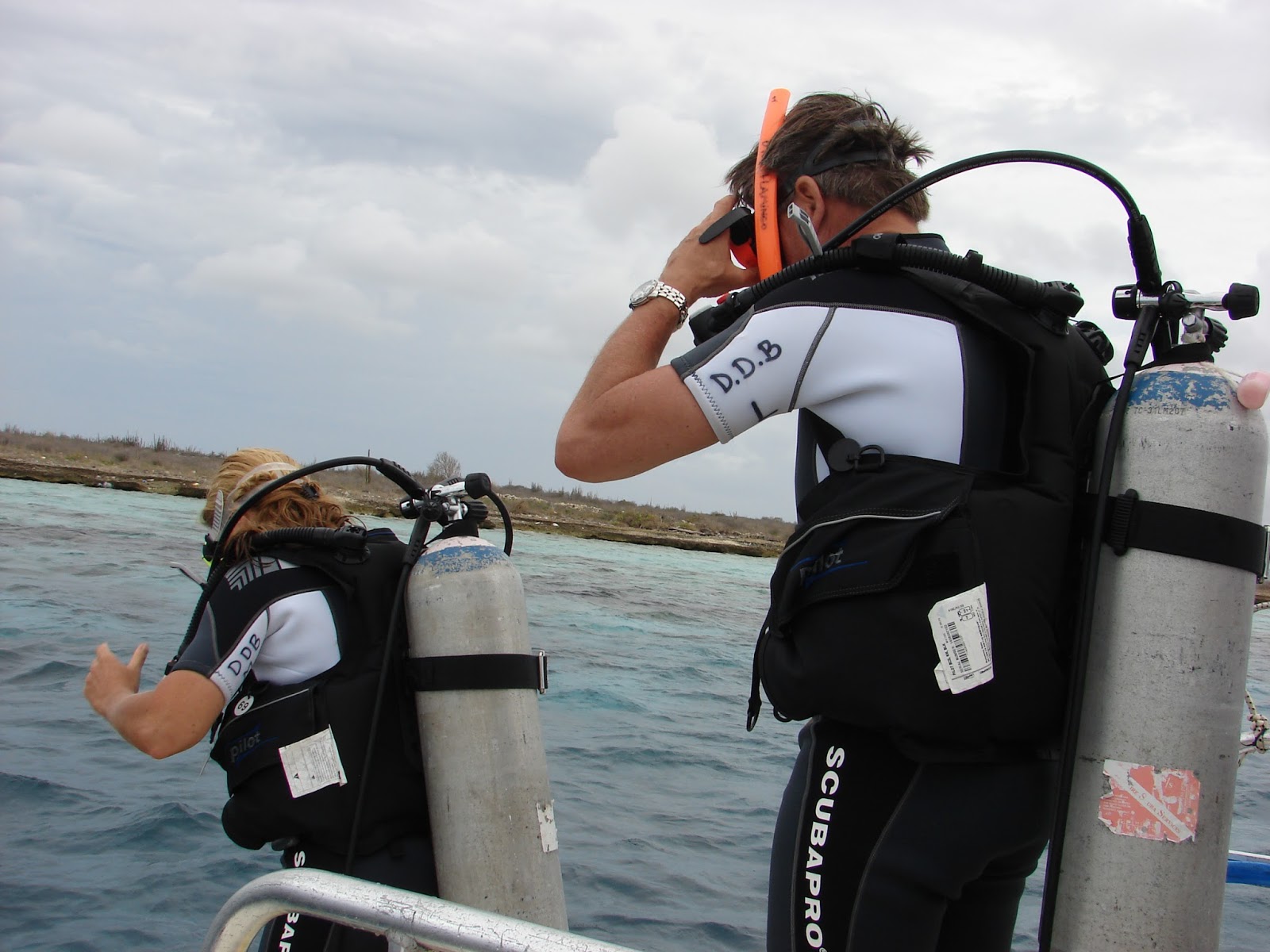
Bonaire is a popular place for people who love to dive and snorkel.  The island is ringed by coral reefs that are teaming with fish.  We love to snorkel. We try to float quietly in the water so the fish in the reef are not afraid and come out of hiding.  We try not to touch any fish or the coral. One of the fish we saw
was a lion fish. It is the one fish that guides are allowed capture. The fish was not originally from the Caribbean Sea.  It is called an invasive species.  It doesn’t have any natural enemies in the Caribbean.  Scientists think someone in Florida dumped the lionfish from the tropical fish tank in the ocean; they spread and multiplied. Today there are too many and they are killing off native plants and animals. 

Did you ever think about where your salt comes from? It may have come from Bonaire.  We were amazed by the huge pyramids of salt on the island. Roland, our guide, explained how the salt was produced.  All salt comes from the ocean at one time.  Some of it is mined from underground.  There was a huge salt mine in Syracuse. That is why Syracuse is called, “The Salt City” and there is a street called “Salina” which comes from the word “salt.” We visited the Salt Museum in Liverpool and learned out they used to mine salt in Syracuse. 

In Bonaire they get the salt directly from the sea.  They say the salt
is made by the “sea, sun, and wind.” There are wind mills that control gates that allow the sea water to flow into what they call “salt pans” but are really shallow lakes of salt water.  As the water evaporates the salt water in the pans turns light green and then a beautiful rose color.  It is a pretty sight.  After many months the sun and wind
cause the water to evaporate leaving just the salt. The salt is scraped up and piled high – very high – in pyramid shaped mountains where it stays until a ship comes along to be loaded and shipped all over the world.  Roland showed us small slave huts. During the slavery time the slaves were used to work in the production of salt. The huts we saw were a big improvement from the ones they had before that.  The slave’s  homes and families were in Rincon at the other end of the island. When the slaves had time off they had to walk six hours or more to visit their families 


Salt has been important for 1000s of years.  It is used for many
things. We use it to make our food taste better and to melt the ice on the roads but it is used in 14,000 different ways including making plastic, paper, glass, soaps, and many other things. 

The word “salary” comes from the Latin word for salt because some people think that the Roman army was paid in salt but it is possible that they only guarded the salt road. Jesus told his disciples, “You are the salt of the earth,” Which meant that they were extremely important. Until the 1900s people in the African country of Ethiopia were paid in salt. We didn’t realize how important salt is. 

Monday, December 2, 2013

Annie and Blue in the Dominican Republic

Santo Domingo is the capital of the Dominican Republic and the first European-built city in the
New World. Santo Domingo was founded by Christopher Columbus’ brother Bartholomew in 1498 who was lieutenant-governor of the Indies.  Christopher Columbus landed on the island in 1492 and called it Hispaniola.  Columbus thought he was in the Indies and we still call the people Columbus met Indians.  Columbus never learned he had found a large continent not known to Europeans.  And, he never found the gold and other riches. When he died he thought he was a failure.

Do you know where Columbus is buried?
When we were in Seville, Spain we saw the bronze coffin with four statues holding it as if they were carrying it. It is said to hold the remains of Columbus. However, the people of the Dominican Republic say he is buried in Santo Domingo.
In Santo Domingo we took a city tour that says learn about “500 years of history in 45 minutes.” On the tour the guide pointed at the cathedral and said in 1877 workers at the cathedral found a heavy lead box with bones in it. A sign on the box said “Illustrious and distinguished male, don Cristobel Colon.” In English it would be “Mr. Christopher Columbus.” The box was returned to where it was found until it was moved to the Lighthouse in 1992. The Lighthouse was built to celebrate the 500th anniversary of Columbus’ voyage to the New World.  In Santo Domingo the resting place is simpler.  The huge new building is called The Lighthouse and is shaped like a cross with a bright beacon at night.

We think it is amazing to walk the same streets that Christopher Columbus walked over 500 years
ago.  A lot of history has taken place in the historic center of Santo Domingo and, at one time, it was a walled city. Many of the walls and gates are still there.  We visited the house of Columbus’ son, Diego, and Casa Reales, which is where the royal court met. Both are museums with many items from the days of Columbus.  They had a great map of Columbus’ voyages. Columbus never made it to what is now the United States.

Before Columbus arrived the island was inhabited by Native Americans call Taino. It was thought at there were three million Tainos when Columbus arrived but 50 years later there were only about 5,000 left.  They died from overwork, mistreatment and diseases brought by the European for which they had no immunity.  It is still possible to see Taino carvings on rocks.  We saw some when we visited Los Tres Ojos which means The Three Eyes in English.  Los Tres Ojos is a series of small underground lakes that must have been a special place for the Taino.  It is magical looking with roots and greenery hanging down from the open hole in the
ground above the small lakes.  To get to one of the small lakes, our guide, Juan pulled us across a lake on a raft hooked to a rope and then we walked a short distance to a beautiful lake.  There were a lot of stalactites and stalagmites.  Do you know what they are? They are pointy stone formations found in limestone caves.  Some hang down like icicles others point up. We learned that “the mites go up and the tites come done” but maybe a better way to remember which is which is that the one with a “g” in it refers to the one on the ground and the one with a “c” refers to the one on the ceiling. I think it would have been fun to go swimming there but it wasn’t allowed. 

Wednesday, November 6, 2013

Visiting Haiti

Haiti is a very interesting country on the Caribbean island of
Hispaniola. Christopher Columbus stopped in Haiti in 1492. France and Spain divided the island with the French getting control of the western part that is Haiti. In the 1700s Haiti was one of the richest colonies in the world.  They used slave labor to produce coffee and sugar. But in 1804 the slaves revolted and created the first black republic in the world and the first country in the Western Hemisphere to abolish slavery.  Other countries that had slaves were afraid their slaves would revolt, too, so they isolated Haiti and didn’t trade with them. Haiti became a very poor country.  And, things got worse for Haiti on January 12, 2010 when a powerful earthquake occurred in the capital of Port-au-Prince killing 300,000 and leaving about one million homeless. 

We found the people of Haiti to be friendly and working hard. There were many interesting things to see.  In the capital of Port-au-Prince one of the interesting places we visited was called the Iron Market.  It is a market filled with people selling things. It is like a mall.  The building was made of iron in France and was supposed to be a train station in Cairo, Egypt but it ended up in Haiti during the 1800s.  The earthquake damage has been repaired and it was reopened in 2011 by former President Bill Clinton who has a foundation that is helping Haiti. Many of the shops in the Iron Market have crafts made by the Haitians.  We visited the village of
Nouailles where we could hear a lot of hammering because the people were making beautiful works of art from old steel drums.  And, in Jacmel we visited a shop where people were making bright, colorful objects from cardboard.  Amazing what people can make out of nothing!

While we were in Jacmel we went to a folkloric show. We love folkloric shows because it is a way people preserve their heritage. The dances were very colorful. We also saw Paper Mache creations and masks that are part of a huge celebration and parade called Carnival.  We would like to see the celebration to watch the parade, see the dances, and hear the great music.  When we were at Moro’s shop he put on one of the Paper Mache masks he made – a giraffe mask.  

In the north of Haiti we visited the Citadel.  It is the most amazing
fort we have every visited. Most forts are built on the water to stop armies from attacking but the Citadel was built on top of a mountain.  The Citadel was built so the Haitians would have a safe place on the mountain to defend themselves if the French tried to recapture the county.  We learned something interesting. One of the reasons the French sold the Louisiana Territory to America was so they would have money to recapture Haiti but it didn’t work out and luckily Haiti was not attacked.

The Citadel was constructed by 20,000 workers between 1805 and 1820. To get to the fort we took a road half way up the mountain to a parking lot where we got in a four-wheeler called a Rhino to go the rest of the way.  It was very curvy and steep.  Along the way we saw the school children walking home from school.  Can you imagine walking one hour or more up a steep hill with the temperature 90 degrees to get home from school – every day? They must have been tired and hot but the girls looked so nice in their colorful uniforms and matching ribbons in their hair.